810 million women are still offline. Coverage isn't the reason.
GSMA's Claire Sibthorpe on the 810 million women in low- and middle-income countries still not using mobile internet, why over 90% of them already live under a mobile broadband signal, and the rising memory prices that could push handsets further out of reach.
The GSMA's Mobile Gender Gap Report 2026 lands on a number that is hard to shrug off. In low- and middle-income countries, 810 million women are still not using mobile internet, against 595 million men. Women in those markets remain 12% less likely than men to be online. That is roughly 200 million fewer women connected.
Our industry's reflex, when it hears a number like that, is to reach for a coverage map. That reflex is wrong, and the report says so plainly: more than 90% of the people who are not using mobile internet already live in an area covered by mobile broadband. Globally, 3.1 billion people sit under a mobile broadband signal they do not use.
So the signal is there. The gap is everything downstream of the signal: the price of the handset, whether you can read and write confidently, whether you feel safe online, and who in the household actually controls the phone. You cannot build your way out of that with more masts.
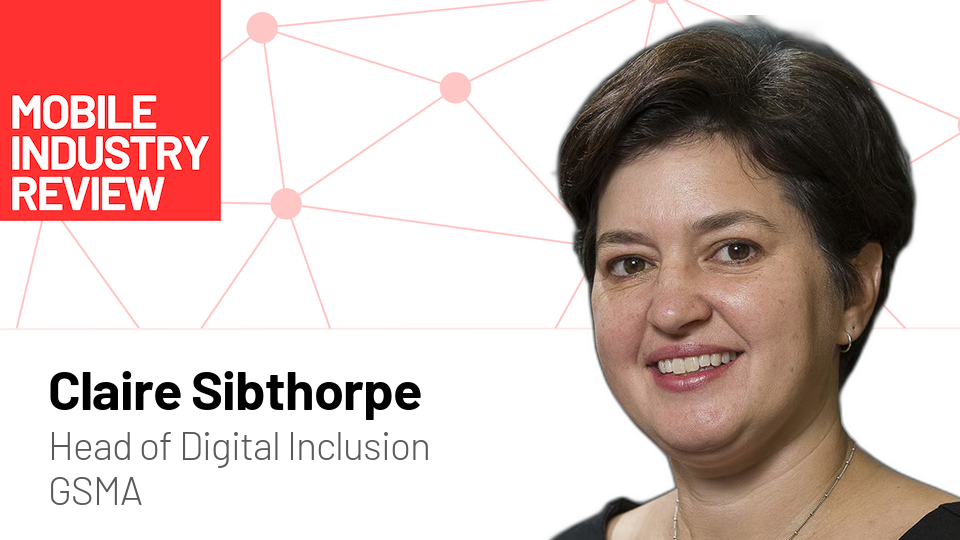
I put this, and a few other awkward questions, to Claire Sibthorpe, Head of Digital Inclusion at the GSMA. To her credit she engaged with the hard ones, including which well-funded programmes quietly failed and why the market has not simply closed this gap on its own.
Over to Claire.
The headline is stark: 810m women still offline in low- and middle-income countries, against 595m men. But the gap in mobile ownership has been narrowing for years while the internet use gap stays stubborn. What's the disconnect - is this now a usage and affordability problem rather than a handset problem?
More women are using mobile internet than ever before, and the gender gap in mobile internet adoption across low- and middle-income countries (LMICs) has narrowed slightly in the last year. But women in LMICs are still 12% less likely than men to use mobile internet, which translates to around 200 million fewer women online. At the same time, 810 million women are still not using mobile internet.
Awareness of mobile internet can be an important barrier to mobile internet adoption, especially for women, but even when they are aware of mobile internet, our survey data shows that affordability (particularly of handsets) remains their top reported barrier to mobile internet adoption. In fact, in LMICs, women are 13% less likely than men to own a smartphone. Alongside affordability, literacy and digital skills and safety and security concerns continue to limit both adoption and further mobile internet use. So, the challenge is increasingly about whether women in LMICs have both the means to access mobile internet and the skills to use it safely and effectively.
You put the cost of the gender gap at $1.3trn in lost GDP. How is that figure built, and when you put it in front of finance ministers or operators, does a number that big actually change behaviour - or does it become so abstract it gets nodded at and shelved?
Given that mobile is the primary - and often only - means of accessing the internet in LMICs, closing the gender gap can be a critical enabler of economic growth. The $1.3 trillion figure is built from modelling the impact of closing the gender gap in mobile internet adoption across LMICs between 2023 and 2030 on GDP (looking at how it impacts economic output). Mobile internet is a general-purpose technology that improves the productivity of firms and workers. It also lowers search and information costs of consumers and producers, enabling new transactions and improving existing ones, stimulating more trade and competition. More detail on the calculation of this number can be found in our State of Mobile Internet Connectivity Report 2024.
It is important to highlight that addressing the mobile gender gap not only delivers significant benefits to women (enabling them to connect with each other and access information, healthcare, education, income-generating opportunities, e-commerce and financial services from anywhere), businesses (a significant revenue opportunity) and society (e.g. supporting the achievement of the UN Sustainable Development Goals), but also economies. Sizing and quantifying the opportunity is important. Highlighting the scale of the opportunity helps to raise awareness of the importance of addressing this issue.
How much of the gap is upstream of the phone entirely - basic literacy? In many of these markets women are less likely to be able to read and compose text in the first place. When you strip that out, how much of the connectivity gap is genuinely about access and affordability, versus foundational literacy that no handset subsidy will fix? And do voice, visual or voice AI change that equation?
Literacy and digital skills are consistently among the top barriers to mobile internet usage reported by women, and these are closely linked to broader structural inequalities such as lower levels of education and income. In many LMICs, women experience these types of barriers more acutely than men, which limits their ability not just to get online but to use mobile internet confidently and regularly.
It is important to holistically address the range of barriers that women face - affordability and access alone won't close the gap. The mobile gender gap is driven by a complex set of social, economic and cultural factors that result in women experiencing barriers to mobile ownership and use including affordability, knowledge and skills, relevance, access and safety and security concerns. These are the same barriers men face but women tend to experience these barriers more acutely due to structural inequalities and underlying social norms, including disparities between men and women in terms of education and income.
Technologies such as voice interfaces, visual tools and emerging AI capabilities do have the potential to reduce reliance on text and lower some barriers. However, they complement rather than replace the need for sustained investment in literacy, digital skills and user confidence for women in LMICs.
Two-thirds of unconnected women are in Sub-Saharan Africa and South Asia - very different markets, with different operators, regulation and social norms. Is there a single lever that works across both, or has the "global digital inclusion" framing outlived its usefulness?
It is true that more than two thirds of the 810 million women in LMICs who are still not using mobile internet are in Sub-Saharan Africa and South Asia, but these regions are not uniform. Women are 26% less likely than men to use mobile internet in Sub-Saharan Africa and 25% in South Asia, yet the underlying drivers can differ significantly across countries and communities. Factors such as social norms, levels of education, income distribution, market maturity and regulatory environments all play a role.
There are common barriers, particularly around affordability, literacy and digital skills and safety and security concerns, that need to be addressed but there is no one size fits all approach that works everywhere in the two regions. To achieve meaningful change policymakers, industry and other stakeholders must work together and take informed targeted action which addresses women's needs and the barriers they face to accessing and using mobile internet.
A global digital inclusion framing is useful in setting direction, outlining the key barriers that need to be addressed and mobilising stakeholders, but it needs to be paired with locally tailored approaches. Progress tends to be stronger where interventions are informed by local context and designed around women's specific needs and barriers.
Women are 2-3x more likely to be unconnected in rural areas. Is that a coverage problem the operators can fix with infrastructure, or does coverage exist and the barrier is everything downstream of the signal - cost, devices, who in the household controls the phone?
The data shows that the gender gap in mobile internet adoption is two to three times wider in rural areas than in urban areas across LMICs. This is not primarily a coverage problem. More than 90% of those not using mobile internet live in areas covered by mobile broadband.
96% of the global population live in areas covered by mobile broadband networks. However, 3.1 billion people (38% of the world's population) live in areas covered by mobile broadband but do not use it.
In many rural areas, mobile internet coverage exists but women are still less likely to be connected. In those cases, the barriers sit downstream of the signal. Affordability of devices and data, lower levels of literacy and digital skills, safety concerns and household dynamics all play a role. For example, who owns or controls the phone within a household can be a significant barrier in some countries. While infrastructure is a necessity, it is not sufficient on its own to close the rural gender gap.
Be specific for our readers: which intervention has produced the biggest measurable jump in women's connectivity in recent years - and which well-funded, well-meaning programme quietly didn't work?
One of the clearest examples of measurable impact has come from targeted operator commitments. Through the GSMA Connected Women Commitment Initiative, more than 50 operators have made formal commitments to accelerate women's digital and financial inclusion, collectively reaching over 90 million additional women with mobile internet or mobile money services since 2016. The common factor in success is a clear focus on women's needs and barriers, backed by measurable targets, ongoing tracking and an engaged group of operators pushing in the same direction.
By contrast, interventions that are not designed with women's needs in mind have tended to be less effective. When stakeholders do not proactively consider how to reach women with their product and service design or marketing and distribution approaches, they often inadvertently reach significantly more men, thus widening existing gender gaps.
It is also important for stakeholders to holistically consider the range of barriers that need to be addressed when designing and implementing initiatives. Not doing so constrains the potential impact of these initiatives. For instance, efforts to improve women's digital skills through digital skills training is hindered if those women do not have access to affordable handsets on which to learn and practice, so supporting handset ownership is important when delivering digital skills campaigns. Similarly, improving the availability of affordable internet-enabled handsets can have limited impact if women are not aware of why it would benefit their lives and do not know how to use them (and use them safely). As such including customer education as part of handset initiatives is important to increasing their impact.
Operators have commercial reasons to care - these are unserved customers. So why hasn't the market closed this gap on its own? Where's the genuine business case, and where does it still need subsidy or regulation?
There is a strong commercial rationale for operators to close the gender gap. Closing the gap in mobile ownership and use could deliver around $230 billion in additional revenue to the mobile industry over an 8-year period. Women represent a significant unserved and underserved customer segment, and increasing their connectivity drives both subscriber growth and data usage over time.
However, the barriers that women face cannot be addressed by one stakeholder alone. It requires action by all stakeholders - policy makers, mobile operators, the development community and others - working together to ensure that women and their families can reap the full benefits of connectivity. For instance governments have a role to play in increasing affordability (e.g. through tax reform - see the impact of South Africa's removal of the 9% ad valorem luxury excise duty on entry-level smartphones) and improving literacy and skills. Support, targeted interventions and partnerships by all stakeholders all play a role alongside commercial initiatives.
If you had one realistic ask of the mobile industry by this time next year, what is it - and what's the single number you'll be watching in next year's report to know whether anything actually shifted?
A realistic ask is that stakeholders prioritise addressing the digital gender divide. That, as the mobile operators who have made commitments through the GSMA Connected Women Commitment Initiative have done, they make clear commitments with targets and take concrete action to holistically address the barriers women face to accessing and using mobile internet. This is critically important to ensure that women are not being left behind in our increasingly digital world, and to realise the significant socio-economic and commercial opportunity of closing the mobile gender gap.
In terms of measurement, the most important indicator to watch is the mobile internet gender gap itself, currently at 12% in LMICs. Progress in recent years has been slow and uneven, so what matters is not only whether the gap narrows, but whether the pace of narrowing accelerates. A meaningful shift in that number, alongside reductions in the total of 810 million unconnected women, would signal that interventions are starting to deliver at scale.
A concern is the rising cost of memory prices, which will make smartphones much less affordable. Since handset affordability is already a very significant barrier to being able to go online, it is critical that it is an issue that is prioritised by stakeholders.
Many thanks to Claire Sibthorpe for taking the time to share her insights with Mobile Industry Review. You can learn more about the GSMA on their website, and read the full Mobile Gender Gap Report 2026.